
When the Company Speaks in Pieces: How Fragmented Corporate Narratives Damage Trust and Valuation
When a controversy hits a company, the natural instinct is for everyone with credibility to help. The CEO wants to reassure investors. The legal counsel wants to clarify compliance. The communications head wants to correct misinformation. Each acts with good intentions. Each speaks truth as they understand it.
But the market does not receive these messages as individual contributions. It receives them as a stream. And when that stream contains variations in tone, emphasis, or timing, analysts do not think “many people are helping.” They think “management is not aligned.”
This is narrative fragmentation. It occurs when multiple authorized voices from the same company send messages that, while individually accurate, collectively confuse. In an environment where valuation depends on perceived stability, confusion is interpreted as risk.
In corporate governance, narrative clarity is as essential as financial performance. Investors, employees, customers, regulators, and partners all rely on a single, coherent understanding of a company’s strategy, risk profile, and future prospects. When a corporation communicates through uncoordinated spokespeople or inconsistent channels, it risks not only confusion but also failure of trust — a core determinant of enterprise value.
Unlike operational missteps, narrative fragmentation does not leave a direct audit trail. It appears instead in investor reports, press releases, ESG disclosures, and social media updates that fail to align. When these messages contradict one another — intentionally or by accident — stakeholders are forced to choose which version of the story to believe. In markets increasingly sensitive to information quality, this ambiguity drives skepticism and heightens perceived risk.
Legal and industry analyses show that inconsistent messaging undermines investor confidence.
How fragmentation damages corporate value
Narrative fragmentation erodes market confidence in three distinct ways.
The first is analyst confusion. Analysts who receive multiple messages must work to reconcile them. Most will default to the most conservative interpretation. They will assume the worst and adjust valuations accordingly.
The second is credibility dissipation. When a company speaks with one voice, each statement reinforces the last. When it speaks with many, each statement competes for attention and belief. The total stock of credibility remains the same, but it is spread across multiple messengers, each less authoritative than a unified voice would be.
The third is vulnerability to short-term speculation. Competing messages create opportunities for selective trading. A short seller can quote the most defensive statement to prove trouble ahead. Another can quote the most candid admission to prove undisclosed problems. Both can claim to be quoting the company itself.
Why this happens in corporations
Publicly listed companies face particular structural challenges. The CEO sets strategic direction. The CFO addresses financial matters. The legal counsel manages regulatory compliance. Board members have oversight responsibilities. All feel entitled to speak on matters within their domain.
The CEO who understands that the legal counsel is speaking about legal matters while the communications head speaks about public perception expects the market to make the same distinction. The market does not. It hears the company’s lawyers saying one thing and its executives saying another, and it concludes that leadership is not aligned.
During regulatory reviews, various officers may offer perspectives on compliance status. Each speaks from their respective mandate. Each is accurate within their frame. But the collective impression can be of a company lacking internal coordination. Share price may suffer. The review period may be extended while leadership works to present a unified position.
What disciplined corporate communication looks like
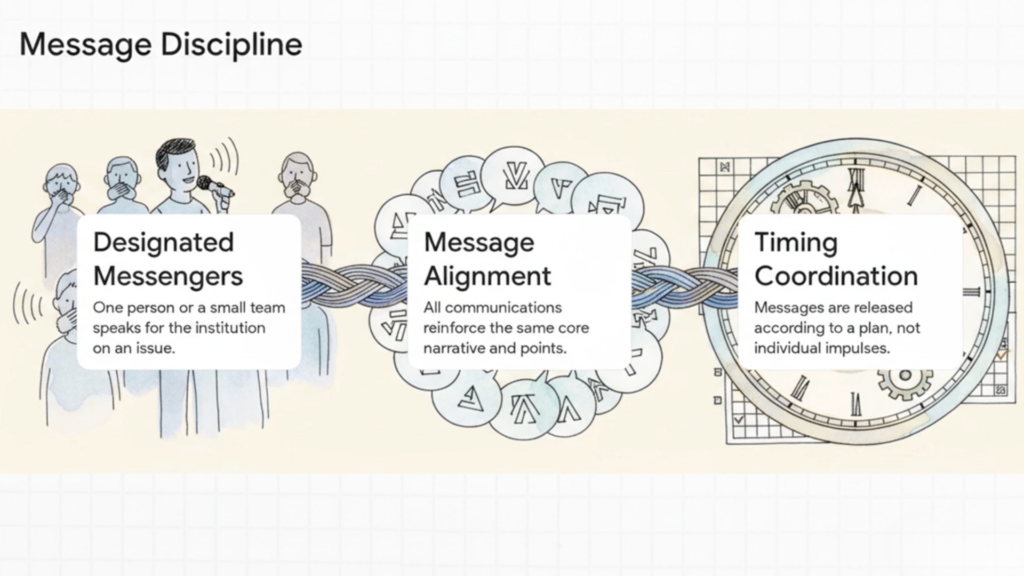
Companies that maintain trust during controversy share one characteristic: message discipline. This rests on three principles.
The first is designated messengers. One person, or a very small team, speaks for the company on any given issue. Others refer inquiries to that person. This is not about silencing expertise. It is about ensuring that expertise is channeled through a single authoritative source.
The second is message alignment. All communications reinforce the same core points. Tone may vary by audience. Detail may vary by context. But the underlying narrative remains consistent enough that an investor hearing two different communications recognizes them as coming from the same company.
The third is timing coordination. Messages are released according to a plan, not in response to individual impulses. This prevents the appearance of chaos that comes when statements appear at unpredictable intervals from unpredictable sources.
What executives must demand
Corporations must integrate communications across legal, investor relations, marketing, and sustainability functions, ensuring that every public message reinforces a unified strategy. Senior leadership must own the narrative framework rather than delegating it to isolated spokespeople. And every external communication should be evaluated through a central coherence test — is this message consistent with what we have said before? Does it align with material disclosures?
In an age where information spreads rapidly and stakeholders interpret signals instantaneously, narrative coherence is as much a governance imperative as audit transparency or regulatory compliance. Fragmentation does more than confuse; it erodes trust, weakens stakeholder alignment, and ultimately depresses valuation.
Published by Padaion by Narra® – apublic explainer platform focused on institutional understanding
Padaion Explainers
Padaion explainers are designed for briefing materials, internal analysis and public communication. Organizations requiring customized versions, sector-specific adaptations or ongoing monitoring may engage with Padaion for licensed advisory
Topic: Corporate Communications | Region: Nationwide | Last Reviewed: 2-13-26 | Last Updated: 2-16-26 | Methodology
Sources:
Securities and Exchange Commission. (2022). Guidelines on Public Communications by Publicly Listed Companies . SEC Memorandum
Institute of Corporate Directors. (2023). Board Governance and Crisis Communications: A Handbook for Directors. Manila: ICD.