
Governance During Institutional Stress: How Public Explainers Prevent Escalation
When agencies come under fire, the difference between crisis and containment often comes down to whether anyone bothered to explain how things actually work
EVERY INSTITUTION FACES moments of acute stress. A corruption allegation surfaces. A service failure goes viral. A regulatory lapse draws national attention. In these moments, the agency itself becomes the story, and the public becomes a participant in how that story unfolds.
The relationship between public scrutiny and institutional behavior is more complex than most assume. Scrutiny can correct and cleanse. But it can also distort and paralyze. Understanding the difference matters not just for the officials involved but for citizens who depend on these institutions to function.
When the public fills the void
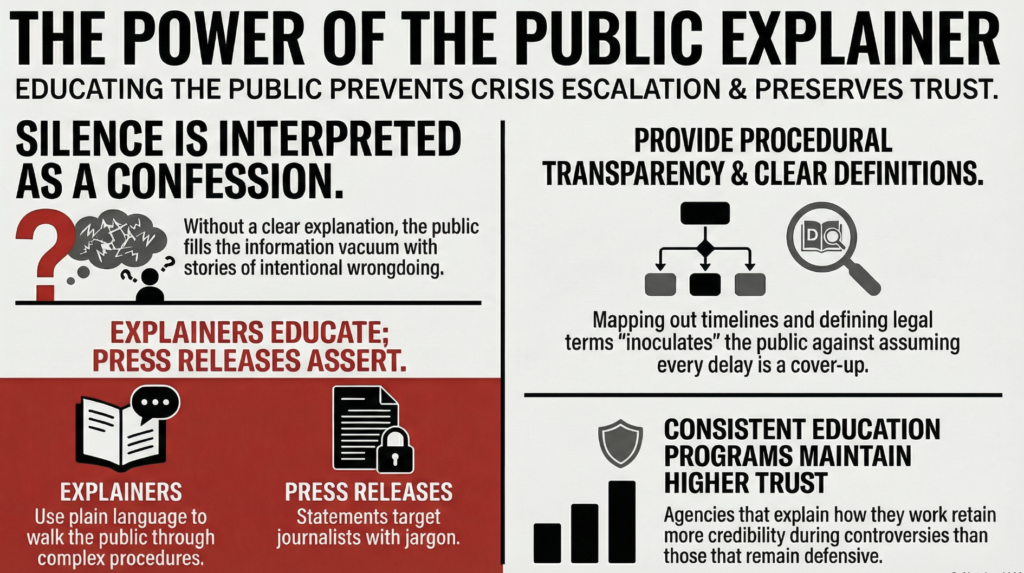
In the absence of explanation, the public does not wait for clarity. It constructs its own narrative using whatever materials are available. Headlines become facts. Allegations become conclusions. Silence becomes confession. Sometimes that story is correct. Sometimes it is not. But whether correct or not, once it solidifies, it becomes resistant to later correction. A clarification issued weeks after an allegation has traveled halfway around the world has already been left behind by the story the public settled on.
This dynamic creates a specific kind of institutional danger. The agency that fails to explain itself in the opening days of a controversy is not simply losing the PR battle. It is allowing the public to adopt a framework that later facts will struggle to dislodge.
What explainers do that statements do not
Press releases are written for one audience: the journalists who might cover the story. They assume readers already understand the context, the legal framework, the procedural requirements. They use technical language because they are written by people who have forgotten that most citizens do not know what a preventive suspension is or why an investigation takes six months instead of six days.
Explainers are written for a different audience: the public itself. They begin from the premise that the reader knows nothing about how the institution works and needs to be walked through it step by step. They define terms. They distinguish between allegation and proof. They explain why silence during an investigation is often legally required rather than strategically chosen.
The Department of Budget and Management demonstrated this approach in 2022 when questions arose about its cash programming system. Instead of issuing a defensive statement asserting that everything was fine, it published a plain-language guide to how cash programming actually works, why adjustments are sometimes necessary, and what safeguards prevent misuse. The guide gave the public a framework for understanding what they were seeing.
The Commission on Audit has done similar work with its Citizen’s Audit Reports, which translate technical audit findings into accessible language. These documents do not defend agencies that performed poorly. They explain what the audit found and what it means.
The anatomy of a public explainer
A well-constructed explainer during institutional stress typically contains several elements that distinguish it from traditional crisis communication
The first is procedural transparency. The explainer lays out what is happening now, what will happen next, and how long each step typically takes. It does not promise speed. It promises predictability. When the Civil Service Commission faces questions about an administrative case, its most effective response is often a simple timeline: here is where the case stands, here is what happens in the next phase, here is when a decision can reasonably be expected.
The second is terminological clarity. Every field has its jargon, and governance is no exception. Preventive suspension. Fact-finding investigation. Formal charge. Probable cause. These terms mean specific things, and the difference between them matters. An explainer that defines them does not just inform. It inoculates against the assumption that every procedural step is evidence of guilt.
The third is distinction without defense. An explainer can acknowledge that something went wrong without accepting that the wrongdoing was intentional or corrupt. It can explain that a delayed project may reflect procurement complexity rather than malfeasance. It can describe the difference between a violation of procedure and a violation of law.
The Office of the Ombudsman’s public information materials model this approach. When high-profile cases attract attention, the office issues not just case updates but explanations of the legal standards being applied. It explains what constitutes proof of graft versus proof of negligence. It explains why some cases proceed to trial while others are dismissed. The public may not like the outcomes, but it understands why they occurred.
Why explainers prevent escalation
The preventive function of public explainers operates on several levels simultaneously.
At the most basic level, explainers reduce uncertainty. Uncertainty is the fuel that drives escalation. When people do not know what is happening, they assume the worst. When they understand the process, they can situate each development within that process. A delay becomes expected rather than suspicious. A silence becomes procedural rather than conspiratorial.
At the second level, explainers create shared vocabulary. A public that knows what probable cause means can engage with the substance of a case rather than its emotional valence. A public that understands the difference between administrative and criminal liability can calibrate its demands accordingly.
At the third level, explainers protect institutional legitimacy during the vulnerable period between allegation and resolution. Legitimacy is hardest to maintain when facts are uncertain and emotions are high. An institution that has taught the public how to evaluate it can survive that vulnerable period with its credibility intact.
The Bangsamoro Autonomous Region in Muslim Mindanao demonstrated this during its first years of operation. Facing skepticism from multiple quarters, the region’s government invested heavily in explanatory materials about its budget process and legislative calendar. When controversies arose, they arose in a context where the public already understood how the institution worked. The result was scrutiny without paralysis.
When explainers fail
Not every explainer succeeds. Some fail because they arrive too late. By the time the institution explains itself, the public has already settled on a story that no explanation can dislodge.
Some fail because they explain the wrong thing. An agency facing questions about corruption that publishes a guide to its procurement procedures has missed the point. The public does not want to know how procurement works in general. It wants to know whether this particular transaction was handled properly.
Some fail because they sound like defense. An explainer that spends more time asserting integrity than describing process will be read as what it is: a dressed-up press release. The public can tell when it is being taught and when it is being sold.
The most common failure, though, is simpler. Most institutions do not write explainers at all. They write statements. They issue denials. They go silent. They wait for the storm to pass. And when the storm passes, they find that something has changed. Trust is lower. Credibility is diminished. The next storm will be worse.
The institutional case for explanation
There is a pragmatic case for this approach that has nothing to do with altruism or good citizenship. Institutions that explain themselves during stress suffer less long-term damage than institutions that do not.
This is measurable. Surveys conducted by the Philippine Statistical Research and Training Institute have found that agencies with consistent public education programs maintain higher trust ratings during controversies than agencies without such programs. An agency that has taught the public how to evaluate it is given the benefit of the doubt. An agency that has not is assumed guilty until proven otherwise.
Trust is not a single reservoir that gets drawn down with each controversy. It is built through repeated interactions over time. Every explainer published, every process clarified, every term defined is a deposit in that account. When a controversy hits, the account balance determines whether the agency has enough credit to survive.
The public’s half of the bargain
None of this works if the public refuses to engage. An explainer is not a magic spell. It is an offer. The public has to accept it.
Acceptance does not mean agreement. It means engagement. It means reading the explainer, understanding the process, and using that understanding to calibrate demands. It means distinguishing between problems that deserve outrage and problems that deserve patience.
This is harder than simple outrage. Outrage is easy. It requires nothing but emotion. Understanding requires work. It requires reading, thinking, and withholding judgment until judgment is warranted.
But the alternative is a public that cannot distinguish between corruption and incompetence, between delay and cover-up, between a guilty official and an innocent one caught in a slow system. That public does not get better governance. It gets more outrage, louder demands, and outcomes that satisfy no one.
The longer view
Public explainers are the tool that makes this possible. They do not resolve controversies. They create the conditions under which controversies can be resolved properly, with due process, without the institution collapsing in the meantime.
The public that understands this dynamic is better positioned to demand what actually works: not faster blame, but better systems. Not performative outrage, but persistent engagement. Not the satisfaction of seeing officials humiliated, but the slower, harder work of ensuring that services improve and corruption declines.
Scrutiny is essential. But scrutiny without understanding is just noise. And noise, however loud, does not build better governance. It only makes it harder to hear the signal.
Published by Padaion by Narra® – a public explainer platform focused on institutional understanding
Topic: Governance | Regions: Nationwide | Last Reviewed: February 16,2026 | Last Updated : February 16, 2026 | Methodology
Sources:
Ateneo School of Government. (2023). Local Government Unit Performance Monitoring Report. Quezon City: Ateneo de Manila University
Bangsamoro Autonomous Region in Muslim Mindanao. (2022). Budget Transparency Report. Cotabato City: BARMM Ministry of Finance.
Civil Service Commission. (2022). Uniform Rules on Administrative Cases: A Primer for Citizens. CSC Resolution No. 1101502.
Commission on Audit. (2023). Citizen’s Audit Report: A Guide to Understanding COA Findings. Quezon City: COA.
Department of Budget and Management. (2023). National Budget Preparation Process: A Citizen’s Guide. Manila: DBM.
Office of the Ombudsman. (2023). Understanding Ombudsman Processes: A Public Information Handbook. Quezon City: Ombudsman.
Mendoza, R. U., & Olfindo, R. (2023). Institutional Trust and Governance Communication. Philippine Journal of Public Administration, 67(1), 45-72.
Philippine Statistical Research and Training Institute. (2023). Public Trust in Government Agencies: Longitudinal Survey Results. Quezon City: PSRTI.