
When Agencies Speak Separately: Why Fragmented Messaging Weakens Public Trust in Cebu
Why this explainer exists
When a controversy hits a government agency, the natural instinct is for everyone with credibility to help. The Mayor wants to reassure constituents. The city administrator wants to clarify procedures. The provincial information officer wants to correct misinformation. Each acts with good intentions. Each speaks truth as they understand it.
But the public does not receive these messages as individual contributions. It receives them as a stream. And when that stream contains variations in tone, emphasis, or timing, the public does not think “many people are helping.” It thinks “they cannot get their story straight.”
This is narrative fragmentation. It occurs when multiple authorized voices from the same government send messages that, while individually accurate, collectively confuse.
In Cebu, governance pressure rarely arrives quietly. It comes through radio commentary, Facebook posts, barangay chatter, press conferences, and national headlines all at once. When controversy hits, the speed of interpretation often outpaces the speed of explanation.
This is where many institutions lose control of the situation without realizing it.
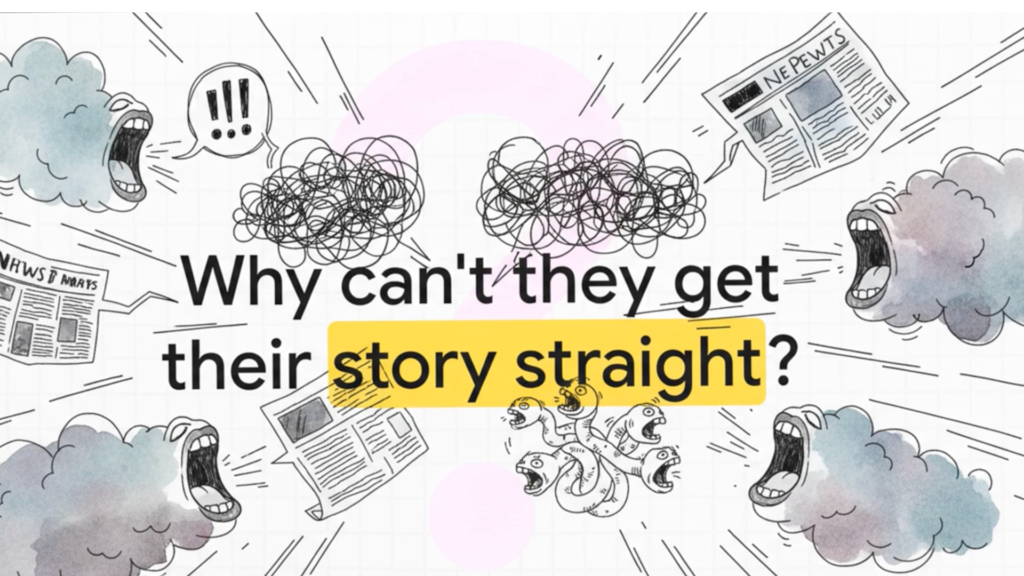
Cebu’s governance landscape is dense. National agencies operate alongside provincial offices, city halls, district representatives, and special authorities. Each has a mandate. Each has a spokesperson. Each feels compelled to respond when public attention intensifies. Without coordination, these responses create a familiar pattern: multiple voices, slightly different explanations, and a public left to decide which version to believe.
That fragmentation is not just a communications issue. It is a trust issue.
When one office says an investigation is “ongoing,” another says it is “under review,” and a third says it is “being evaluated,” the public does not hear nuance. It hears inconsistency. In Cebu, where institutional memory is long and skepticism toward authority is well earned, inconsistency quickly turns into suspicion.
This is how escalation begins.
In the absence of a clear explainer, people fill in the gaps. Radio hosts speculate. Social media simplifies. Silence is interpreted as guilt. Delay is read as cover-up. By the time formal processes reach their conclusions, the public narrative has already settled.
Cebu has seen this cycle repeat across infrastructure delays, procurement questions, and personnel controversies. Often, the issue is not the existence of a problem but the absence of a shared explanation of how the system is supposed to work while the problem is being addressed.
A statement declares position. An explainer establishes understanding. For a Cebu audience, that difference matters. Explain what a preventive suspension actually means. Explain why a procurement review takes months, not days. Explain which office decides what, and when. These are not technicalities. They are the difference between containment and chaos.
Institutions that explain early reduce speculation later. When the public understands the steps of a process, each development fits into a timeline rather than triggering outrage. Delays feel procedural, not evasive. Silence feels bounded, not strategic.
This is particularly important in Cebu, where local and national narratives collide. A national agency may speak with Manila assumptions, while local audiences interpret events through lived experience. Without a Cebu-grounded explainer, messages drift, and trust erodes.
Narrative coherence does not require fewer voices. It requires aligned voices. Agencies that operate in Cebu need a shared explanatory framework during stress, one that prioritizes clarity over defensiveness and process over posture.
Explainers prevent that confusion. Not by defending institutions, but by making them intelligible while pressure is highest.
What local executives must demand
For governors, mayors, and agency heads, the implication is straightforward. Narrative fragmentation is a leadership failure, not a communications failure. It happens when leaders have not established clear protocols, designated clear messengers, or enforced clear discipline.
Discipline is not oppression. It is the precondition for trust. And in an environment where every inconsistency is amplified, it is the only thing that ensures the public hears what the government actually means to say.
Published by Padaion by Narra®- a public explainer platform focused on institutional understanding
Topics: Governance | Region: Central Visayas | Last Reviewed: 2-16-26 | Last Updated: 2-16-26 | Methodology
Sources:
Department of the Interior and Local Government. (2023). Local Government Communications Protocols: A Best Practice Guide. Manila: DILG.
University of the Philippines Cebu. (2023). Local Government Communications Practices: A Survey of Information Officers. Cebu City: UPC.
https://theconversation.com/why-mixed-messaging-can-erode-trust-in-institutions-147631